Chapter 4: Bright Eyes on Hollywood
Shirley finally burst onto the Hollywood scene and attracted the attention of everyone at Fox. The attention led Winfield Sheehan to schedule a meeting with Gertrude to discuss his concerns about Shirley becoming spoiled; from Shirley’s memoir: “Sheehan had begun by noting favorable press reviews of my films, but quickly noted that some experts were already warning of pitfalls ahead… he said that although I knew how to steal a picture and how to be beloved by adult members of cast and crew, my cuteness would not last much longer… my career might well be brief, and at its conclusion, my personality a shambles.” (p. 55) This is unfortunately a common practice among studio execs; Sheehan put his foot down to demand that Gertude exert more control over her daughter; he went so far as to forbid Shirley from dining at the studio’s commissary. (this is a bizarre move, and likely one that shows not only that Sheehan contradicted himself in his statements to Gertrude, but will also potentially build resentment towards Shirley) Sheehan also insisted that Shirley spend her time when not on set in a cottage previously used by other actors. (it seems Sheehan is deliberately sequestering Shirley away from her peers, yet he does not want her to be spoiled?)
Even though Shirley’s star status was solidified, that did not stop Gertrude from providing her a stable home life, or even disciplining her: one of the downsides of fame was having fans find her house and delusionally believing they could pay a visit to meet the starlet. (as you can imagine, this issue has worsened with the advent of social media and technology) Shirley shared an anecdote in her memoir she probably would have preferred not to share: around this time a group of fans came to her house wanting to meet her; Gertrude requested her presence in the front hall and asked her to provide a quick performance for the visitors. Shirley’s response: “…I stuck out both my chin and lower-lip and shook my head.” (Temple, 58) In response, Gertrude sent the visitors away, directed Shirley to another room, got out a wooden yardstick and instructed her to pull down her pants and bend over; Shirley received her first (and not last) spanking. I completely disagree with the way Gertrude handled this situation: what kind of message does this send when she thought it would be a good idea to let strangers into her house, then request her starlet daughter perform a quick routine, then punish her when she refuses? This event occurred around two years after Charles Lindbergh Jr’s kidnapping and murder, so it surprises me that she thought this was a good idea. (this will somewhat be addressed in a later chapter) Ironically enough, Shirley offered Gertrude comfort after the spanking due to Shirley’s desire to please everyone who meant something to her.
Paramount was pleased with the success of Little Miss Marker, and requested another loan-out of Shirley from Fox to star opposite Gary Cooper and Carole Lombard in Now and Forever, a film about a swindler who decides to take possession of his daughter who is living with the brother of his deceased wife. Shirley expressed enjoyment working on this film, specifically working with Gary (who interestingly enough nicknamed her “Wiggle-Britches”) and Carole. In the middle of filming, a story floated around the studio about the death of Dorothy Dell, Shirley’s co-star from Little Miss Marker in a car accident; Paramount kept the story quiet, however before she shot her most dramatic scene that required tears, someone on the set let the story spill, causing Shirley to cry genuine tears. (which is what you see in the scene) In her memoir, Shirley expressed her preference for crying fake tears.
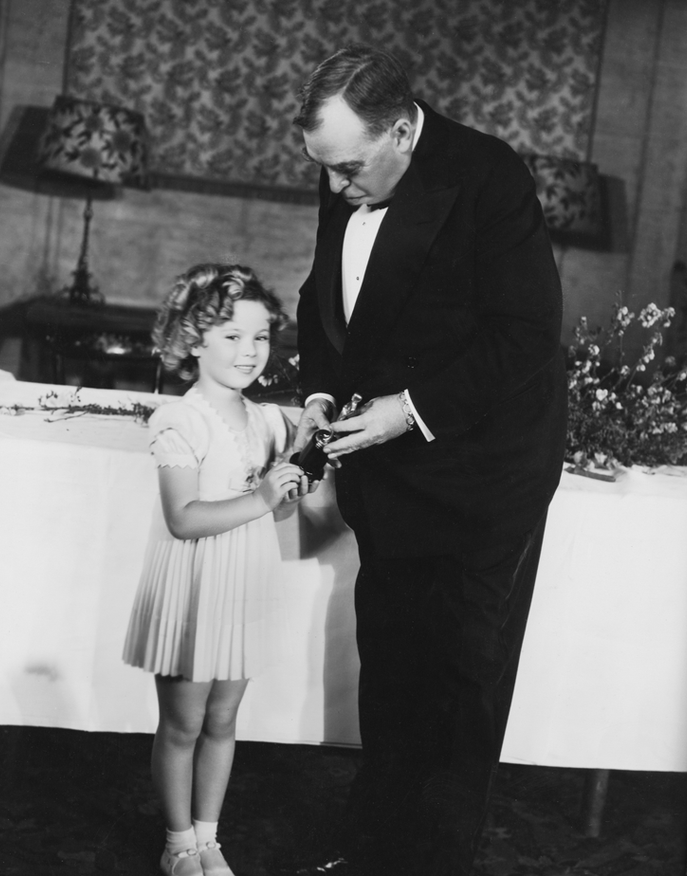
In late 1934, Shirley would receive top billing for the film that solidified her Hollywood stardom: Bright Eyes. Shirley portrays Shirley Blake, a girl whose father is deceased and mother gains employment with a snobby upper-class couple and their young daughter. Shirley spends the majority of her time with her godfather Loop Merritt (played by James Dunn, the actor whom she co-starred with in Stand Up and Cheer! and Baby Take a Bow). As her mother is heading to the airport where Loop lives to attend a Christmas party he throws for Shirley, she is hit by a car and dies, leading to a dispute between the uncle of the couple her mother was employed with and Loop to adopt her. (this is the film where you see Shirley bring “On the Good Ship Lollipop” to life) The film was an instant hit, and lead to a string of Shirley Temple-branded products that side-stepped any consent on the part of her parents, including a line of dolls, a line of dresses, and a fashion book. Even though these false endorsements were a consequence of Shirley’s rise to fame, the greatest gift of the film’s success was winning a juvenile Oscar at the 1935 Academy Awards. (fun fact: in her memoir, Shirley disclosed she had no idea she would win an award and rushed the stage when she heard her name called with Gertrude and George tailing her; humorist Irvin Cobb presented her the award, but only if she gave him a kiss on the cheek, which she only did because she could see the award. When she received the award, she thanked Cobb, then asked Gertrude if she could go home).
Shirley’s rise to Hollywood stardom is now undeniable. Can this lucky streak continue?


Comments